

Vulcaflex is a renowned company in the elastomer market, recognized for its quality and commitment to its partners, working on the development of technical solutions for customers in national and international markets.
When it comes to adhesive systems for belt splices using the cold bonding method, our development, manufacturing, and application engineering teams work together to deliver sustainable and reliable technical solutions for the processes of the world’s largest companies in the conveyor belt segment, evaluating both tensile stress in cold splices and the physicochemical characteristics of our adhesive lines.
Achieving excellence in performance in elastomeric bonding systems requires working with the highest-quality raw materials available on the market: specialty elastomers, high-performance chemical additives, ultra-high-purity solvents, among others — always strengthening relationships with our suppliers with a focus on the continuous improvement of their products. In addition, catalysts are carefully specified to work with a high degree of compatibility with the polymeric base, promoting fast and stable crosslinking over time, ensuring reliability in the application of cold splicing work on conveyor belts.
Vulcaflex’s engineering teams are also actively engaged and contribute to the standardization process in ABNT working groups, applying normative references throughout our entire production chain, as well as in the quality control of adhesive batches through mechanical testing.
In recent months, a study was completed evaluating the aging behavior of RSX 2300 Adhesive for periods of up to 360 days post-cure, comparing two distinct pressure application methods (rolling with high-pressure rollers and 12 mm manual rollers):
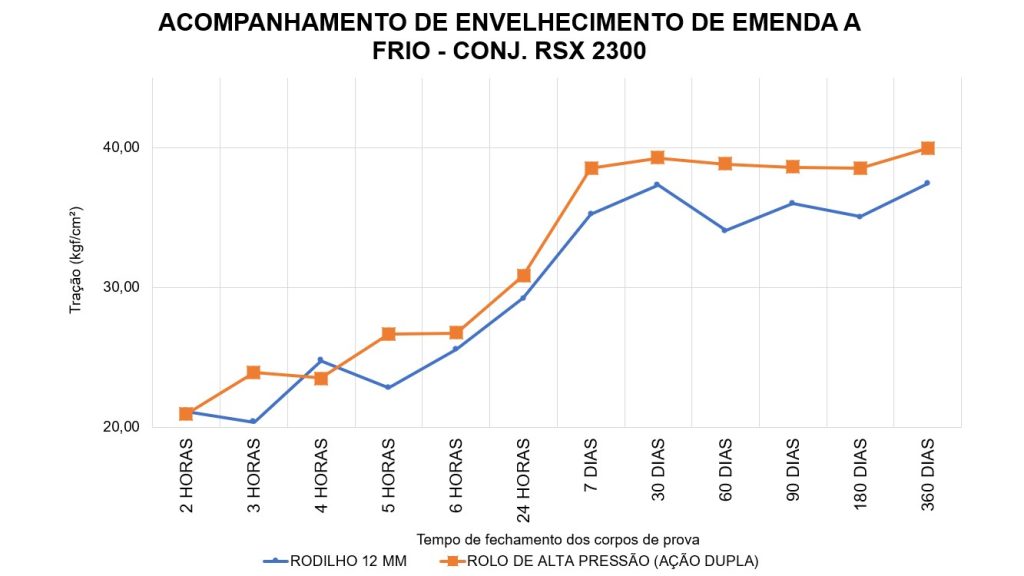
This study was fundamental to the update of ABNT NBR 15391 standard, 2022 version, and the results show tensile shear strength values for the test specimens well above those required by the technical specifications of the most demanding engineering sectors.


